Industrial Diesel Generator hire

Diesel generators for planned and emergency Applications

Solve your commercial power generation challenges with our diesel generator rental service.

Fast and flexible diesel generator hire

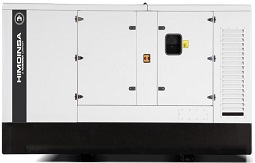
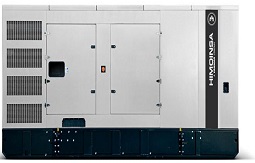
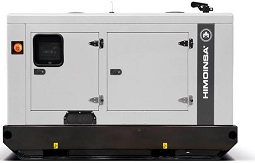
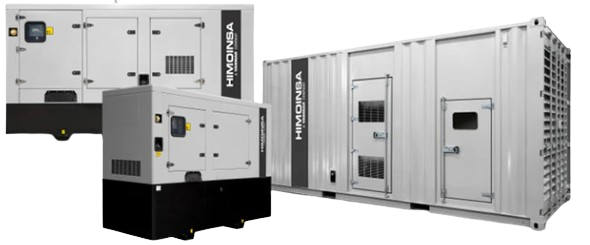
Our diesel generators range in size from 30 to 2100 kVA and are available in either a soundproofed canopy or 20-ft ISO container for enhanced security, durability and easy transportation by road, rail, sea or air.

Modular in design, our diesel generators for hire packages can be scaled up or down to give you the voltage and power you need. We can combine our diesel generators in different ways to deliver the exact amount of power for your site. If your power demands fluctuate, we’ll design a load-on-demand set-up where our portable diesel generators automatically turn on and off to meet the site’s load demands. This means we only provide the power you need when using our diesel generator rental service, saving on fuel, emissions and costs.

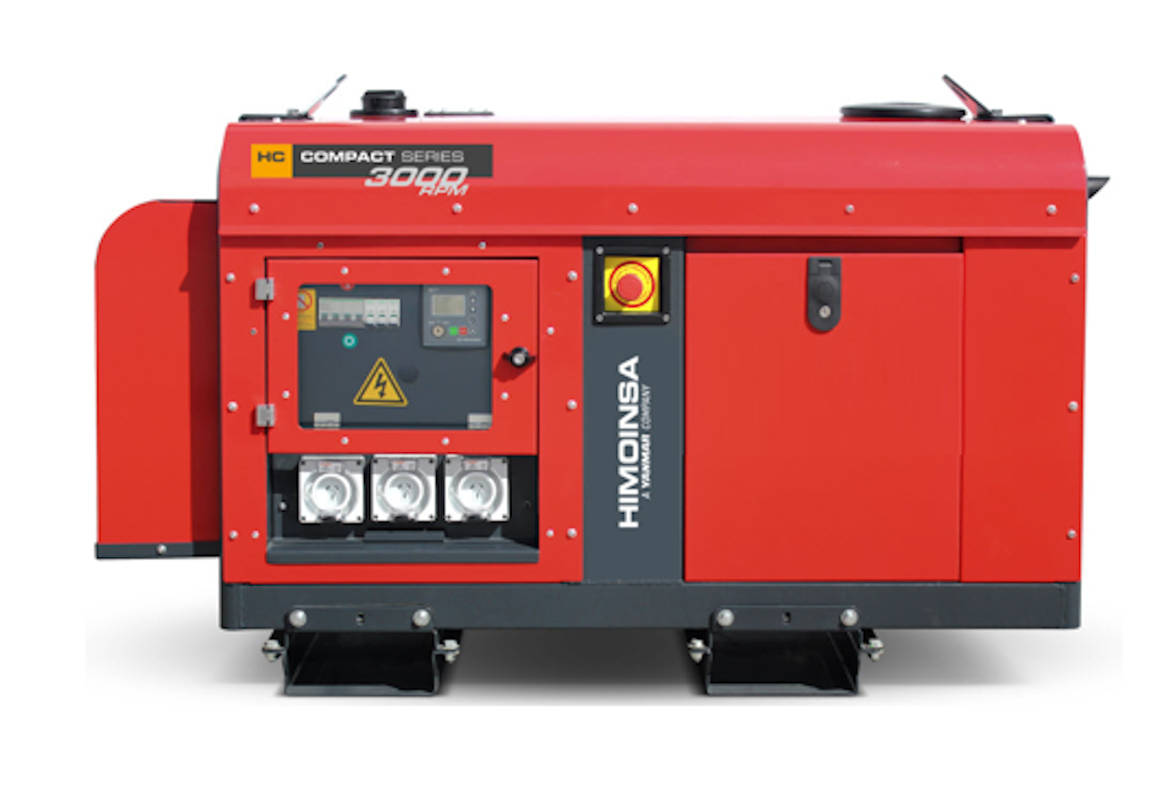
Compact Series (Single Phase)

5.5 kVA Generator set Soundproof

Model: HCY-6 M5
Single phase | 50 Hz | Diesel | Complying EPA
8 kVA Generator set Soundproof

Model: HCY-9 M5
Single phase | 50 Hz | Diesel | Complying EPA

Compact Series (Three Phase)

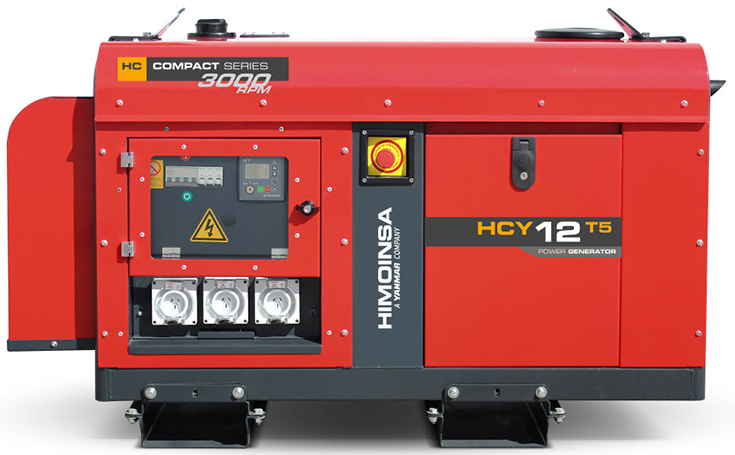
11.3 kVA Generator

Prime: 5,50 - 11,30 kVA
Standby: 6 - 12,50 kVA
Model: HCY-12 T5
Three phase | 50 Hz | Diesel
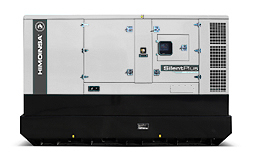
Silent Plus

20 kVA Generator

Model: HRYW-20 T5 S+
Three phase | 50 Hz | Diesel | Stage 3A
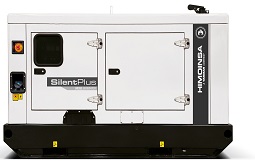
34 kVA Generator

Model: HRYW-35 T5 S+
Three phase | 50 Hz | Diesel | Stage 3A
42 kVA Generator

Model: HRYW-45 T5 S+
Three phase | 50 Hz | Diesel | Stage 3A

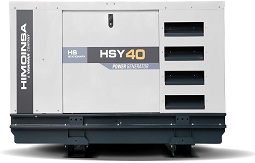
HS | Stationary Range

HSY Series

Prime: 6,60-51 kVA
Standby: 7,20-59 kVA

HSF Series

Prime: 60-228 kVA
Standby: 63-251 kVA

Silent Plus

HRFW Series

Prime:60-301 kVA
Standby: 63-330 kVA

HRSW Series

Prime:501-501 kVA
Standby: 550-550 kVA

Industrial Range

HYW Series

Prime:6-597 kVA
Standby: 6,50-656 kVA

HDW Series

Prime:199-863 kVA
Standby: 220-949 kVA

HFW Series

Prime:60-598 kVA
Standby: 63-657 kVA

HBW Series

Prime:155-769 kVA
Standby: 170-827 kVA

HSW Series

Prime:250-700 kVA
Standby: 275-711 kVA

HMW Series

Prime:601-664 kVA
Standby: 660-730 kVA

HJW Series

Prime:60-250 kVA
Standby: 63-275 kVA

Heavy Range

HBW Series

Prime:810-1.385 kVA
Standby: 860-1.523 kVA

HDW Series

Prime:812-1.034 kVA
Standby: 910-1.145 kVA

HYW Series

Prime:1.260-2.601 kVA
Standby: 1.350-2.627 kVA

HTW Series

Prime:670-2.555 kVA
Standby: 738-2.816 kVA

HMW Series

Prime:910-2.572 kVA
Standby: 1.003-2.809 kVA

Rental Range

HRYW Series

Prime:12,50-1.305 kVA
Standby: 13,40-46 kVA

HRFW Series

Prime:60-598 kVA
Standby: 63-657 kVA

HRSW Series

Prime:250-703 kVA
Standby: 275-711 kVA

HRMW Series

Prime:600-664 kVA
Standby: 659-730 kVA

Experience Quality and Expertise with Our Diesel Generator Hire Services

Extra Value with AMPTEK SERVICES PTY LTD

Our skilled team is available 24/7 to support your project needs. From emergency 20kVA road-tow generators to high-voltage commissioning projects, we have the expertise to deliver efficient and reliable solutions with our diesel generator hire services.

Innovative, Industry-Leading Diesel Generators

Our generators are designed and constructed to the highest standards at our accredited manufacturing facility, ensuring continual improvements in cleanliness, noise reduction, and efficiency. Certified for safety and emissions, our equipment meets stringent industry requirements.

Environmental considerations are paramount, with superior soundproofing, emission control, and fully bunded fuel tanks to prevent leaks.

Our diesel generators come housed in soundproof canopies or enclosed in custom-designed 20-ft ISO containers, providing added security, durability, and transport convenience by road, rail, sea, or air.

Can't see what you are looking for?

Contact our Diesel Generators Experts

Diesel Generators FAQ

Diesel generators are the most efficient when they are running at their optimum operational range (around 80% of their total load capacity). At optimal load, their Net Electrical Fuel Efficiency is around 40%.

Diesel engines are more efficient than petrol and gas engines due to the ability to operate at higher compression and expansion ratios.

Fuel consumption of the generator depends not only on its size and the operating load, but also on how efficient the model of generator is, how many auxiliary loads (e.g. container fans, fuel pump & control system) are powered by the generator, and how well is the generator maintained / serviced. As a rule of thumb, a diesel generator uses 0.25L of fuel for every electrical kWh produced. For example, a small, 20kVA canopy generator uses, on average, 4 to 5L/h of diesel at 75% prime power 50Hz electrical output, while a larger 1500kVA containerised generator would consume 238L/h at 75% prime power at 50Hz electrical output, or 267L/h at 60Hz.

The combustion of diesel fuel releases greenhouse gases and pollutants. Alternative fuels could be a more sustainable alternative to diesel, and this approach to reduction of GHG is very attractive as it does not require extensive investments. Diesel generators can run on a variety of fuels, including HVO (renewable diesel), synthetic diesel, and biodiesel. 

When replacing diesel with biodiesel, please note that diesel generators manufacturers’ guidelines and recommendations for service intervals and maintenance requirements are specific to their equipment. These guidelines may include details on maintenance tasks such as filter replacements, oil changes, and general inspections. It's important to adhere to these recommendations to ensure optimal performance and longevity of the generator in use.

A measure of apparent power, kVA, or kilo-volt-amperes, reads the complete amount of power that is being used in a system, such as a generator. When such a system is 100% efficient, kW, or kilowatts, are equal to kVA. That being said, electrical systems are never working at 100% efficiency, meaning that only some of the apparent power is being converted into working output. Where one kVA is equivalent to 1,000 volt amps, a volt measures electrical pressure, and an amp measures electrical current. 

A much more common unit of measurement for the majority of electrical appliances, a kW is the level of actual power belonging to an electrical system. Also known as working power, a kW is the amount of power that does valid work. 

While you can use solar panels in conjunction with the generator, you would need an energy storage or an inverter for the system to operate correctly. It’s important to understand that solar panels generate direct current (DC) while a generator provides alternating current (AC power). 

Diesel generators can run for hundreds of hours non-stop, provided the following conditions are met:

  1. Consistent supply of fuel (otherwise, fuel tank capacity will be limiting the run time)
  2. Constant monitoring as per the preventative maintenance plan. 
  3. Servicing requirements are met. Most Aggreko diesel generators have service intervals ranging from 250-400 hours - this would include visual inspection, testing, changing of oil and oil filters.

To determine the size of the generator you would need to rent, you need to take into account the total power requirements of all the equipment you need to run simultaneously, the maximum starting wattage of the most energy demanding equipment, and the ideal usage of a generator running at 80% of its capacity.  As a guide, check out our generator size calculator. 

The maximum size of the generator that can be used in your application depends on the maximum current ratings on the switchboard. If unsure, contact your electrician. 

The choice between a single-phase or 3-phase generator depends on the power requirements of the electrical loads you plan to power. If you only need power tools that require single phase, you can still use a 3-phase generator and use a distribution board to break the power down to single-phase outputs to match your equipment. 

3-phase generators are designed for larger electrical loads such as commercial buildings, data centres, and industrial applications. They provide higher voltage and can handle loads up to hundreds of kilowatts or megawatts. If you plan to power heavy machinery or large industrial equipment, a 3-phase generator is necessary. 

Battery storage systems are great when combined with a generator to dramatically reduce fuel usage and carbon dioxide emissions. However, being a storage system, they require an energy source, either renewable (solar panels or wind turbines) or generator, for recharging. If the battery is idle for a prolonged period of time, it will lose a considerable amount of power (self-discharge) and won’t be able to provide power.